For people living with schwannomatosis, pain has always been one of the strangest parts of the disease.
A tiny schwannoma can be excruciating. A much larger tumor can be relatively quiet. Pain can shoot along a nerve, burn, ache, stab, become exquisitely sensitive to pressure or light touch, or persist even when imaging does not appear to provide a satisfying mechanical explanation.
For years, that disconnect has created a terrible problem for patients:
If the scan doesn't look bad enough, why does it hurt this much?
Research is beginning to give us an answer. And that answer may fundamentally change how we think about SWN pain.
First, the uncomfortable fact: there is no SWN pain medication
No Approved Treatments
There is currently no FDA-approved drug specifically for treating schwannomatosis pain. There is also no FDA-approved drug that stops the underlying tumor process in SWN. This is documented in published clinical guidelines for schwannomatosis management (Evans et al., European Journal of Human Genetics, 2022).
That doesn't mean patients receive no treatment. We do. Doctors borrow medications developed for other forms of neuropathic or chronic pain. Depending on the individual patient, those may include gabapentin or pregabalin, certain antidepressants used for neuropathic pain, sodium-channel-active anticonvulsants, NSAIDs, opioids, and other symptomatic treatments.
But those medications were not developed around the biology of schwannomatosis. That distinction is enormous. A medication can reduce the nervous system's ability to transmit pain without addressing the SWN process that keeps provoking or sensitizing that nervous system.
For decades, we have largely been trying to quiet the alarm. Now researchers are beginning to investigate why the alarm keeps being triggered.
SWN pain may be a circuit
One of the most important recent advances in SWN research comes from models developed using patient-derived schwannoma cells. Researchers found a biological conversation occurring between the schwannoma, sensory neurons, and immune cells. It looks something like this:
Gutierrez et al. (Journal of Pain, 2026) describes this schwannoma–neuron–macrophage crosstalk and reports that macrophages recruited into the dorsal root ganglion produced excessive IL-6. Blocking IL-6 reduced pain in the experimental models, although it had only modest effects on tumor growth.
That is a very different picture from: tumor presses nerve → nerve hurts.
Mechanical compression certainly can cause pain. But it may not be the whole story. The tumor may also be changing the biological environment of the pain system itself. And once we look at SWN pain as a circuit, we suddenly have multiple circuit breakers.
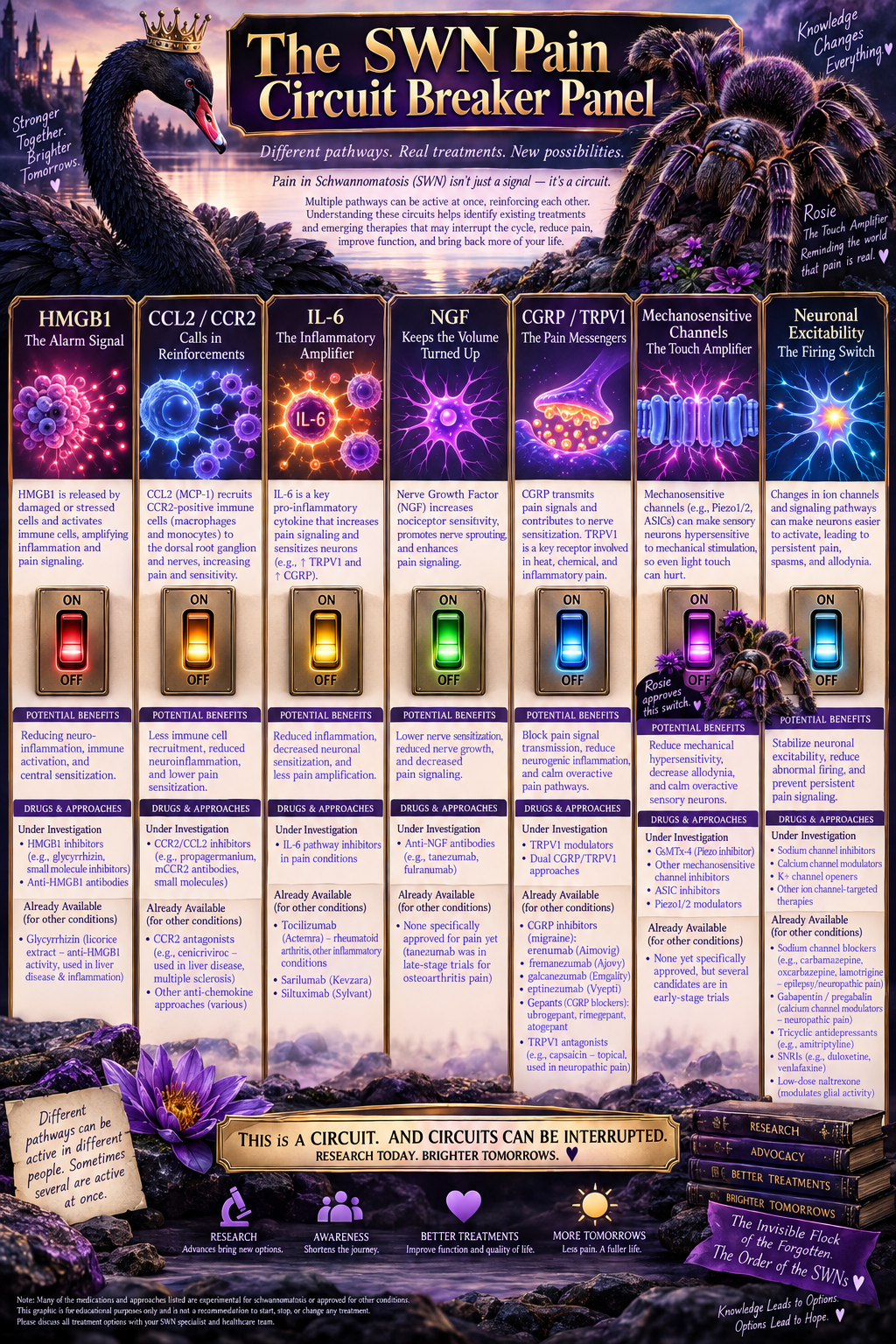
The SWN Pain Circuit Breaker Panel. Seven pathways. Multiple points of attack. Each circuit runs from signal source to the nerve response experienced as pain.
Circuit Breaker 1
HMGB1 — The Alarm Signal
In the experimental SWN pathway, schwannomas release HMGB1, which helps initiate signaling that ultimately recruits inflammatory cells and promotes pain.
That makes HMGB1 an intriguing upstream target. But this is firmly in the research-target category. We should not confuse identifying a molecular target in a disease model with having a medication ready for SWN patients.
For now, HMGB1 tells us something extraordinarily useful: the painful tumor may be sending biochemical distress signals, not merely occupying space.
Circuit Breaker 2
CCL2 / CCR2 — Calling in Reinforcements
HMGB1 stimulates sensory neurons to produce CCL2, which helps recruit CCR2-positive macrophages into the dorsal root ganglion. Those macrophages then become part of the pain-producing environment.
Experimentally blocking CCL2 reduced macrophage recruitment and pain behavior, although researchers also found evidence that biology can compensate through other chemokines. That last part is important: biology rarely gives us one convenient switch labeled OFF. Block one road and the system may find another.
That is one reason combination therapy may ultimately prove more useful than searching endlessly for one mythical SWN pain pill.
Circuit Breaker 3
IL-6 — The Inflammatory Amplifier
Now we arrive at a particularly interesting switch. The recruited macrophages produce IL-6, an inflammatory cytokine. In SWN models, blocking IL-6 reduced pain.
And unlike HMGB1 or CCL2, this pathway already has an FDA-approved drug capable of targeting it. Siltuximab (Sylvant) is an anti-IL-6 monoclonal antibody already used for another disease. It is not approved for schwannomatosis. But it is no longer merely an interesting drug we can point to from another specialty.
Active Clinical Trial — STARFISH
Siltuximab is now being tested in people with SWN pain. The STARFISH trial (ClinicalTrials.gov: NCT05684692) is a phase II platform trial for moderate-to-severe schwannomatosis pain. One of its current experimental sub-studies is testing siltuximab against placebo, with an estimated primary completion in November 2026. No results have yet been posted.
That progression is worth appreciating:
Patient observation → laboratory mechanism → IL-6 identified → existing IL-6 drug → SWN clinical trial.
That is translational research actually moving.
Circuit Breaker 4
NGF — Keeps the Volume Turned Up
Nerve growth factor, or NGF, is another molecule implicated in painful schwannomas. NGF can sensitize nociceptors — essentially making pain-sensing neurons more responsive. Researchers therefore tested tanezumab, an antibody targeting NGF, specifically in people with SWN pain.
This was historically important: it was the first therapeutic trial directed specifically at SWN-related pain. Unfortunately, recruitment was badly disrupted and the study was far too small to establish statistical significance. The investigators considered the observed pain reduction clinically meaningful, but the result cannot be generalized from a trial of this size.
So we cannot say: tanezumab works for SWN.
But we can say something important: targeting a biological driver of pain rather than simply providing another conventional analgesic has now been tested in SWN patients, with a signal interesting enough to justify further study. That is progress.
Circuit Breaker 5
CGRP — The Pain Messenger
This is another particularly interesting pathway because it has now crossed from biological hypothesis into an actual SWN clinical trial.
CGRP is deeply involved in nociceptive signaling and sensitization. It is best known because blocking CGRP or its receptor transformed migraine treatment. Gutierrez et al. (Journal of Pain, 2026) found increased CGRP expression in sensory neurons exposed to the inflammatory environment created by tumor-associated macrophages, and showed that IL-6 blockade reduced that expression.
That raised a fascinating question: could blocking CGRP quiet part of the sensitized SWN pain circuit?
Active Clinical Trial — STARFISH
STARFISH (NCT05684692) is also testing erenumab-aooe, a CGRP-receptor monoclonal antibody already used for migraine prevention. Twenty participants are planned for this sub-study, comparing an early-start group with a delayed-start placebo group before all participants receive active treatment. Erenumab is not an approved treatment for SWN, and results are not yet available.
This is exactly the kind of drug-repurposing opportunity rare-disease research needs: a biological pathway implicated in SWN pain already has a medicine with human safety and pharmacology experience behind it. Instead of beginning at molecule zero, researchers can ask whether an existing tool fits our newly discovered lock.
Circuit Breaker 6
Mechanosensitive Channels — Enter Rosie
Many people with SWN describe something peculiar: touch hurts. Pressure hurts. Clothing over a painful tumor hurts. Sitting against it hurts. Palpation can be excruciating. Movement that mechanically disturbs the area can hurt far more than anyone examining the scan would expect.
Gutierrez et al. (Journal of Pain, 2026) exposed sensory neurons to substances secreted by painful schwannoma cells and found that those neurons became dramatically more sensitive to mechanical stimulation. Even more interestingly, after the neurons were primed, subsequent exposure could produce prolonged mechanical hypersensitivity. Then researchers introduced GsMTx-4.
GsMTx-4 is a peptide originally derived from the venom of the Chilean rose tarantula — and it blocks mechanosensitive ion-channel activity. In the SWN experimental model, GsMTx-4 prevented hypersensitivity to light touch. Remarkably, it also reversed hyperalgesia in the primed state and restored withdrawal thresholds to baseline in the animal model.
That does not mean Rosie has delivered us an SWN drug. GsMTx-4 remains experimental. But the finding suggests that part of SWN pain may involve altered mechanotransduction — the machinery through which physical force becomes an electrical signal. The nerve isn't necessarily receiving a bigger mechanical insult. Its definition of what constitutes a painful mechanical stimulus may have changed.
Why Rosie Matters
Rosie is not our cute spider mascot pasted onto a pain poster. She represents an actual experimental point of attack on the SWN pain circuit. GsMTx-4 comes from the Chilean rose tarantula (Grammostola spatulata) — and research involving painful schwannoma models found that inhibiting mechanosensitive ion channels with GsMTx-4 could prevent the mechanical hypersensitivity caused by factors released by painful schwannoma cells. Rosie is sitting on a very interesting circuit breaker.
Circuit Breaker 7
Neuronal Excitability — The Firing Switch
Eventually all of these signals encounter another fundamental problem: how easily does the neuron fire? That is where many of the medications SWN patients already receive enter the picture.
Gabapentin and pregabalin alter calcium-channel-associated neurotransmitter release. Some anticonvulsants affect sodium-channel activity. Tricyclic antidepressants and SNRIs alter pain transmission through other mechanisms. These medications can reduce neuropathic pain.
But they are not SWN-specific therapies. That distinction helps explain why a patient can experience meaningful benefit from one of these medications without the medication doing anything to the schwannoma, macrophage recruitment, IL-6 production, or other upstream drivers. It is working farther down the circuit. And sometimes that is exactly what a patient needs.
The mistake is assuming that because a downstream medication helps, we have therefore treated the disease mechanism.
Pain and tumor growth may be different switches
Gutierrez et al. (Journal of Pain, 2026) produced another important finding. Blocking IL-6 substantially improved pain in the SWN models but did relatively little to control tumor growth. The study identified EGFR signaling as an important driver of tumor progression and a potential escape mechanism from IL-6 blockade. When researchers experimentally combined IL-6 blockade with EGFR blockade, they achieved substantially better simultaneous control of both pain and tumor growth in the SWN models.
This is preclinical research. But conceptually, it is enormous. It suggests:
Key Insight
Pain biology ≠ tumor-growth biology. They interact. They overlap. But they may not be identical. And that may finally help explain one of the strangest features of schwannomatosis: tumor size is not a pain scale.
A drug could conceivably improve pain without shrinking tumors. A future tumor-directed therapy might shrink tumors without adequately treating an already sensitized pain system. Those are not contradictions if we are dealing with overlapping biological circuits rather than one simple mechanical problem.
What is actually being tested in SWN right now?
| Approach | Circuit Breaker | Where Are We? |
|---|---|---|
| Siltuximab | IL-6 | Phase II STARFISH SWN pain trial — recruiting |
| Erenumab-aooe | CGRP receptor | Phase II STARFISH SWN pain trial — recruiting |
| Tanezumab | NGF | Studied directly in SWN patients; small underpowered phase II showed a clinically meaningful but not statistically significant pain signal |
| GsMTx-4 | Mechanosensitive channels | SWN-specific preclinical research; promising model results, not a human SWN treatment |
| HMGB1 / CCL2 / CCR2 targeting | Upstream inflammatory signaling | Preclinical SWN research targets |
| IL-6 + EGFR blockade | Pain + tumor-growth pathways | Preclinical combination strategy |
| Gabapentin, pregabalin, SNRIs, TCAs, etc. | Downstream neuronal excitability | Existing symptomatic treatments borrowed from other pain conditions — not SWN-specific drugs |
STARFISH is especially interesting because it is not built around the assumption that researchers already know the winner. It is a platform trial, designed so multiple candidate therapies can be screened efficiently in this rare population.
The goal cannot simply be “less pain”
A treatment can lower someone's pain score and still leave them worse off. If pain falls from an eight to a six but the patient is so sedated, dizzy, cognitively slowed, or weak that they cannot function, what exactly did we accomplish?
For SWN, the meaningful target needs two axes:
Can I sleep? Can I walk? Can clothing touch my skin? Can I sit in a chair? Can I use my hand? Can I cook? Can I concentrate? Can I leave my house? Can I work, parent, create, socialize, or participate in the things that make my life mine?
A mathematically improved pain score is not necessarily a meaningful clinical success if function has not improved.
There may never be one “SWN pain drug”
And perhaps we shouldn't expect one. Imagine two patients. One has intense inflammatory signaling. Another has extreme mechanical allodynia. A third has a particularly excitable peripheral nerve. A fourth has a painful, anatomically accessible tumor. A fifth has several of those mechanisms simultaneously.
Giving all five the same medication and concluding that the medication “works” or “doesn't work” for SWN may eventually look extraordinarily primitive.
Instead, the future may be mechanism-informed combination treatment: reduce an inflammatory driver, quiet abnormal nociceptive signaling, control mechanical hypersensitivity, stabilize neuronal excitability, and where necessary, treat the tumor itself. Not necessarily all at once. Not necessarily for every patient. But according to which switches are actually stuck on.
From painkillers to circuit breakers
For decades, the question has largely been:
What can we give this patient for pain?
The emerging SWN science lets us ask a much more interesting question:
The Better Question
What is keeping this patient's pain circuit switched on? HMGB1? CCL2/CCR2? IL-6? NGF? CGRP? TRPV1? Mechanosensitive channels? Abnormal neuronal excitability? The tumor itself? Or several of them working together?
We cannot answer that question for an individual patient yet. We do not have validated biomarkers that allow clinicians to look at someone with SWN and assign them a personalized circuit-breaker combination. That is where the science still needs to go.
But look at how much the question itself has changed. We have moved from:
Pain → painkiller → stronger painkiller → surgery
toward:
Tumor biology → neuronal signaling → immune recruitment → inflammatory amplification → sensitization → mechanical and electrical hyperexcitability → pain and loss of function
And every additional piece of that pathway gives researchers another place to investigate.
There are still no approved medications specifically for SWN pain. That fact should make us angry about how far there is to go. But for the first time, we are not merely searching for stronger ways to endure the signal.
We are learning where the circuit breakers are. And two of those switches are already being tested in people with schwannomatosis. That is not a cure. But it is movement.
Sources
- Gutierrez C et al. Journal of Pain. 2026. (schwannoma–neuron–macrophage crosstalk; HMGB1/CCL2/IL-6/CGRP circuit; GsMTx-4 mechanosensitivity findings; EGFR escape mechanism)
- Evans DG et al. ERN GENTURIS. European Journal of Human Genetics. 2022. (no approved drug therapies for SWN; clinical management guidelines)
- ClinicalTrials.gov NCT05684692 — STARFISH: A Platform Trial for Schwannomatosis Pain (siltuximab and erenumab-aooe sub-studies)
Medical & Research Note
This article describes published research, ongoing clinical trials, and medications approved for other diseases. Except where explicitly stated as being studied in an SWN clinical trial, mentioning a drug does not mean it has been demonstrated to treat schwannomatosis. There are currently no FDA-approved drug therapies specifically for SWN pain. Experimental findings in cells or animals cannot establish that a treatment will be safe or effective in humans. Treatment decisions should be made with clinicians familiar with the individual patient's condition.